

By : sandhya sati
Dehradun: 07 Feb 2026
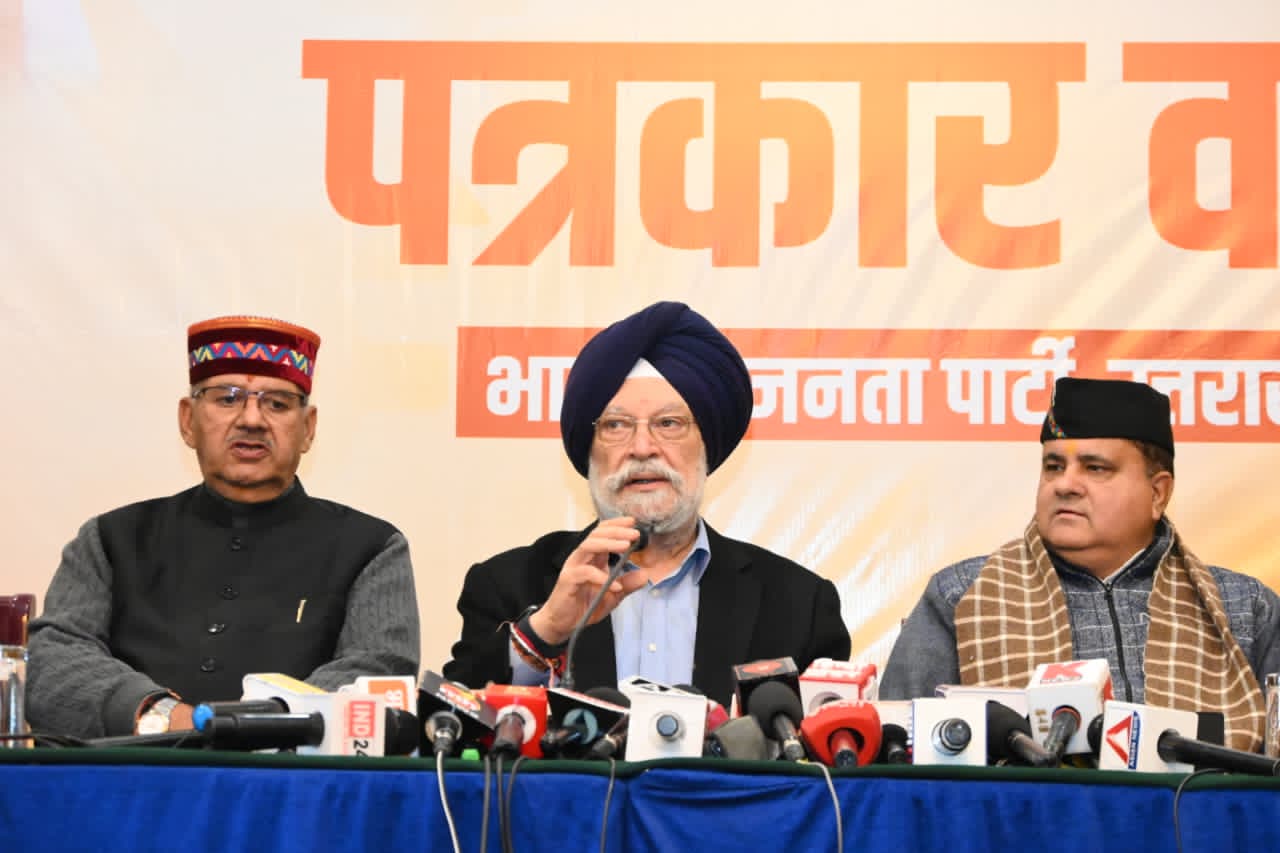
Union petroleum and natural gas minister Hardeep Singh Puri on Friday said the Union Budget 2026–27 reflects the confidence and maturity of a rapidly transforming Indian economy, marking a decisive shift since 2014.
Addressing the media in Dehradun, Puri said the Budget strikes a careful balance between growth and fiscal discipline, underscoring India’s journey from being counted among the “fragile five” economies to becoming the world’s fourth-largest economy and one of the most dependable global growth stories.
He described the Budget as forward-looking and consolidation-oriented, built on reforms undertaken over the past decade while preparing the country for a larger global leadership role. India’s GDP growth for FY26 is projected at 7.4%, driven by consumption and investment, reaffirming its position as the fastest-growing major economy for the fourth consecutive year, even as global growth hovers around 3%.
Highlighting price stability, the minister said India recorded the sharpest decline in headline inflation among major economies in 2025, at around 1.8%. Between April and December 2025, average inflation remained close to 1.7%, aided by lower food prices, particularly vegetables and pulses. India’s inflation levels, he added, are significantly lower than those of many advanced and emerging economies.
Puri emphasised the shift towards capital-led growth, noting that capital expenditure for 2026–27 stands at about ₹12.2 lakh crore—over 430% higher than in 2013–14. Allocations for national highways have risen nearly fivefold, while spending on defence, health and education has increased by over 210%, 176% and 110% respectively.
Infrastructure spending has emerged as a key growth driver, he said, with every rupee invested in national highways adding ₹3.2 to GDP. Since 2014, national highway length has expanded from about 91,000 km to nearly 1.46 lakh km, metro networks have crossed 1,000 km, and the number of airports has more than doubled to around 160.
The minister said sustained investments have strengthened defence capabilities, reduced import dependence and boosted indigenous manufacturing under the Atmanirbhar Bharat initiative. He also highlighted human capital development, pointing out that the number of IITs, IIMs, AIIMS and medical colleges has risen sharply over the past decade, with Indian IIT campuses now operating in Zanzibar and Abu Dhabi.
On connectivity, Puri noted that over 164 Vande Bharat Express trains are currently operational, with plans for 260 sleeper trainsets and seven new high-speed rail corridors using indigenous technology. Under the UDAN scheme, 1.5 crore passengers have travelled on previously unserved routes, helping India become the world’s third-largest domestic aviation market.
Referring to MSMEs and clean growth, he said the Budget builds on recent gains through measures such as a ₹10,000 crore MSME growth fund, a ₹10,000 crore Bio-Pharma Shakti initiative and a ₹2,000 crore top-up to the Atmanirbhar Bharat Fund. Clean energy goals have been integrated through a ₹20,000 crore carbon capture mission and duty exemptions for key clean-energy technologies until 2035.
Summing up, Puri said the Budget recognises a decade of economic transformation and lays the foundation for sustainable, inclusive and innovation-led growth, calling it a “nation-building Budget” aimed at steering India towards a developed and self-reliant future.